

For SaaS companies selling to enterprise and mid-market buyers, a SOC 2 report is likely to become a condition of doing business. The moment you sell to companies that care about where their data goes, their security and procurement teams will ask for your report. This guide explains why SOC 2 fits SaaS so naturally, what it covers for a SaaS environment, and how to approach it.
Why SOC 2 matters so much for SaaS
SaaS means your customers' data lives in your systems. That makes you a vendor in their supply chain, and their security and procurement teams are responsible for vetting you. SOC 2 is the report they recognise as evidence that you handle that data responsibly and maintain adequate data security practices. For a SaaS company, a SOC 2 report shortens security reviews, unblocks enterprise deals, and replaces a hundred back-and-forth security questionnaire emails with one document.
SaaS companies also face a specific challenge: customers commit their confidential data and sometimes personal information to your platform, and they want third-party assurance that your security controls are real, not just claimed. SOC 2 compliance provides exactly that assurance in a form a licensed CPA firm attests to.
What SOC 2 covers in a SaaS environment
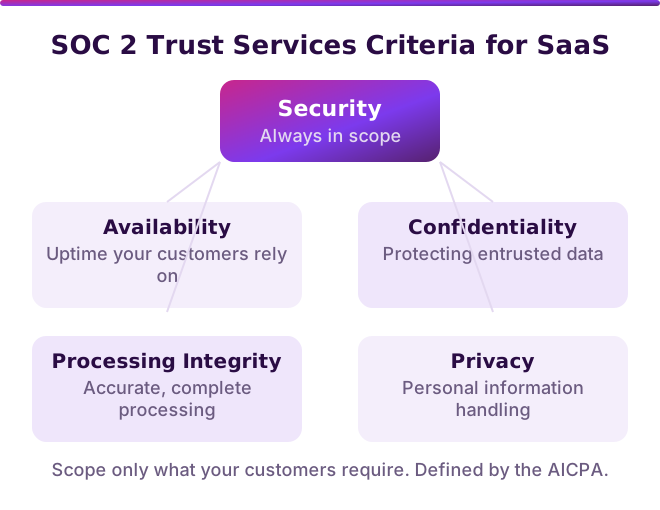
Every SOC 2 covers the Security criterion, and for SaaS the optional Trust Services Criteria often matter. The American Institute of Certified Public Accountants (AICPA) defines the full framework.
- Security is always in scope: access control, encryption, monitoring, change management, and incident response across your application and cloud environment.
- Availability is frequently relevant, because customers depend on your uptime; it covers monitoring, capacity planning, and disaster recovery.
- Confidentiality applies if you commit to protecting specific confidential data that customers entrust to you.
- Processing Integrity applies if accurate, complete processing is core to your service.
- Privacy applies if you handle personal information in ways that warrant it under your privacy policy and commitments.
SOC 2 is distinct from SOC 1, which covers internal controls over financial reporting and is relevant to different service types. SaaS companies almost always pursue SOC 2.
A good readiness process helps you include exactly the Trust Services Criteria your customers expect, because scope drives both cost and timeline. SaaS companies that include every criterion unnecessarily pay more for the audit and the ongoing compliance program.
Not sure which Trust Services Criteria your SaaS actually needs?
Run the free self-assessment and see exactly where your security posture stands before committing to a scope.
The SaaS-specific controls auditors look at
SaaS environments share a common control surface. Auditors examining a SaaS company for SOC 2 compliance typically focus on:
- Cloud infrastructure configuration and least-privilege access in your cloud provider.
- Secure software development and change management in your pipeline.
- Logging and monitoring across the application and infrastructure stack.
- Data security: encryption in transit and at rest.
- Vendor management for the third-party services and integrations you rely on.
- Unauthorized access prevention and detection controls.
- A tested incident response process.
Much of this is good engineering you would want regardless; SOC 2 makes you evidence it.
SaaS compliance requirements from customers
Enterprise buyers of SaaS increasingly require SOC 2 before signing. Some compliance requirements are contractual: your customer's MSA will reference a SOC 2 report as a requirement. Others come through vendor questionnaires or procurement reviews. In either case, a SOC 2 Type 2 report is the most widely accepted form of assurance.
ISO 27001 is another framework some enterprise customers request. SOC 2 and ISO 27001 have significant overlap in the control domains they cover, so completing SOC 2 compliance for your SaaS puts you in a strong position to pursue ISO 27001 if needed.
| Control area | What auditors examine | Why it matters for SaaS |
|---|---|---|
| Cloud configuration | Least-privilege access, security groups, hardening | Your infrastructure is someone else's hardware; misconfiguration is the top risk |
| Change management | Approval, review, and rollback processes for code and config | Continuous deployment means continuous control evidence |
| Logging and monitoring | Centralised logs, alerting, anomaly detection | Auditors need to see you would catch an incident |
| Encryption | In transit and at rest for customer data | Confidentiality and Security criteria both depend on this |
| Vendor management | Review of third-party providers in your stack | Your sub-processors are in scope for your customers |
| Incident response | Written plan, tested process, notification SLAs | Enterprise buyers want to know what happens when something goes wrong |
How to approach it
Most SaaS companies start with a Type 1 to validate control design and get an early report, then run a Type 2 over a monitoring period, unless a customer requires Type 2 up front. Compliance automation tools fit SaaS well because they connect directly to your cloud and pipeline to collect evidence continuously. Scope tightly, implement the controls, document policies that match reality, remediate gaps, and then engage a licensed CPA firm for the SOC 2 audit.
A readiness assessment before your first SOC 2 audit identifies the gaps your SaaS environment needs to close. You want a clean report the first time, and the readiness work is what makes that possible. Many SaaS providers run a SOC 2 audit annually to maintain their report, so building the compliance program correctly from the start pays forward.
How Onyx helps SaaS companies
Onyx provides SOC 2 readiness for SaaS: scoping the right Trust Services Criteria for your stack, running the gap assessment, helping implement controls across your cloud environment and pipeline, authoring policies and evidence, and preparing you for fieldwork with your chosen CPA firm. The SOC 2 report is issued by a licensed CPA firm; we make sure your first audit is a confirmation, not a discovery.
Building toward SOC 2 for your SaaS?
Tell us your stack and what customers are asking for, and we will scope readiness on a short call.
See also: SOC 2 for startups, SOC 2 Type 1 vs Type 2, and SOC 2 readiness assessment. Or take our free security self-assessment for an instant read on your cloud security posture.
The bottom line
For SaaS, SOC 2 compliance is how you prove to customers that their data is safe with you, and it unlocks the enterprise deals that depend on it. Scope the Security criterion plus the optional Trust Services Criteria your customers expect, implement the cloud, pipeline, and data security controls auditors look for, use automation to collect evidence, and sequence Type 1 then Type 2. Treat it as a growth enabler, not just a checkbox.
FAQ
Why do SaaS companies need SOC 2?
Because SaaS holds customers' data, making you a vendor their security and procurement teams must vet. SOC 2 compliance is the report they recognise as evidence that you handle that data responsibly, so it shortens security reviews and unblocks enterprise deals.
Which Trust Services Criteria should a SaaS company include?
Security is always in scope. SaaS companies often add Availability because customers depend on uptime, and may add Confidentiality, Processing Integrity, or Privacy depending on what they commit to and the data they handle. Scope to what your customers expect, since scope drives both cost and timeline. The AICPA defines all five criteria.
What controls does SOC 2 require for SaaS?
Typically cloud configuration and least-privilege access, secure development and change management, logging and monitoring, data security including encryption in transit and at rest, vendor management for third-party integrations, unauthorized access prevention, and a tested incident response process.
Should a SaaS company get SOC 2 Type 1 or Type 2?
Most start with a Type 1 to validate control design and get an early report, then pursue Type 2 over a monitoring period. If a customer requires Type 2 up front, plan straight for it. Designing and operating the controls is the core work either way.
How does SOC 2 help SaaS sales?
A SOC 2 report replaces lengthy security questionnaires and back-and-forth with a single recognised document, shortening enterprise security reviews and removing a common blocker to closing deals. It satisfies vendor compliance requirements and turns your security practices into a sales asset that works for every prospect.