


Search "best penetration testing companies" and you get directories, paid placements, and lists that rank firms you have never heard of by criteria nobody explains. That is not how a security leader actually picks a provider. The "best" penetration testing company is not a name on a list; it is the firm that fits your scope, your compliance need, and your risk, and that you can prove is competent before you sign.
This guide gives you the categories of provider, the criteria that separate a strong firm from a weak one, and a shortlist process you can run this week.
There is no single "best," only the best fit
A boutique team that lives and breathes web application testing and manual penetration testing may be the best choice for a SaaS company and the wrong choice for a bank that needs internal network, cloud, and red team work under one roof. A large consultancy with broad coverage may be ideal for a complex enterprise and overkill for a startup that needs one focused external pen test for a customer's security review. Match the provider to the job, not to a ranking.
Not sure what scope you actually need?
Run the free self-assessment first to understand your risk exposure before comparing providers.
The types of penetration testing provider
You will generally choose from four kinds of firm.
Boutique offensive-security specialists. Small, senior teams focused on security testing. Often the deepest technical talent and the most flexible, best when the work is the priority and you value direct access to the penetration testers.
Full-service security firms. Offer testing across compliance, advisory, and managed security services alongside penetration testing services. Best when you want testing plus help acting on the results, or a single partner across several needs.
Large consultancies. Broad coverage, brand recognition, and scale. Best for large, complex, or multi-region programmes, usually at a premium and sometimes with less direct tester access.
Crowdsourced or platform-based testing. A pool of testers via a testing model built on a platform. Useful for continuous testing and broader coverage, but assurance, scoping, and reporting consistency vary, and they suit a different need than a scoped, point-in-time penetration testing service.
The criteria that actually matter
Whatever category you shortlist from, judge every firm on the same things.
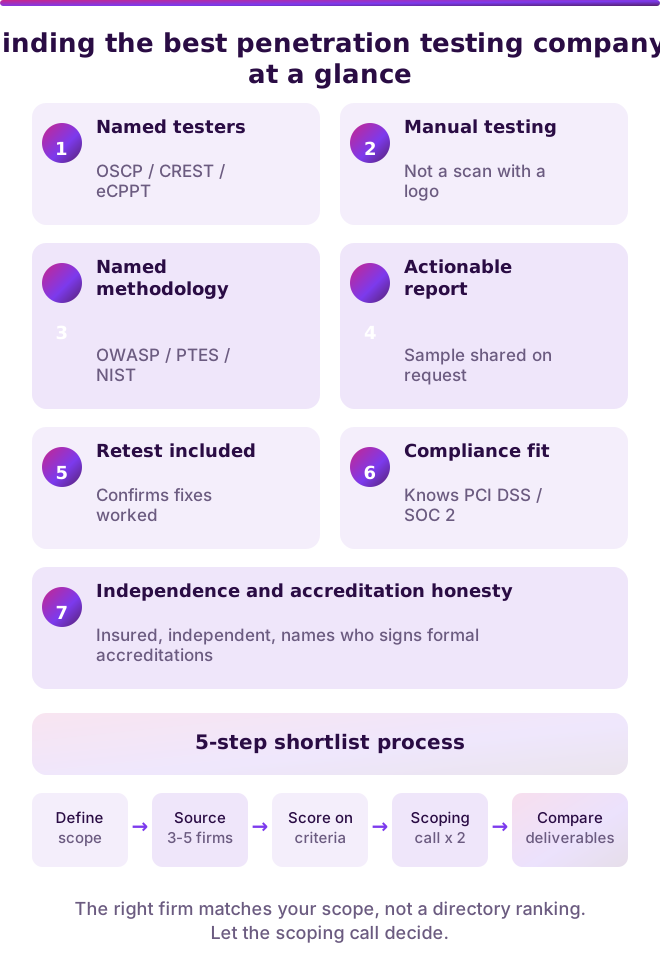
- Who runs the test. Named, certified penetration testers with real exploitation experience, not a sales contact hiding the testing team. Respected credentials include OSCP, CREST individual certifications (CRT or CCT), eCPPT, CRTP, and CEH. Where formal CREST-accredited testing is required, confirm it is delivered by a CREST-member firm.
- Manual testing depth. Real exploitation by hand, not an automated scan with a logo. Ask what is automated and what is manual testing done by a person.
- Recognised testing methodologies. OWASP, PTES, or NIST SP 800-115, with a written scope and rules of engagement.
- A report you can act on. Executive summary, CVSS-aligned findings, reproduction proof, and prioritized fixes. Always ask to see a sanitised sample.
- Remediation and a retest. Developer-ready fixes and a retest to confirm they worked.
- The right compliance fit. A testing provider that knows your framework (PCI DSS, SOC 2, HIPAA) and scopes the test to produce the evidence your auditor expects.
- Independence, insurance, and accreditation honesty. An independent, insured firm that is plain about who signs each formal accreditation.
A shortlist process you can run this week
- Define the scope and the driver (compliance, a customer review, a launch, or genuine assurance). This decides which category of testing service fits.
- Source three to five candidates from your network, industry references, and reputable directories. Top penetration testing providers will have verifiable case studies and clear tester credentials.
- Score each against the criteria above. Ask every firm for a sanitised sample report and the certifications of the actual testers.
- Hold a scoping call with the top two. The quality of their questions tells you more than any list. A firm that scopes carefully before quoting is a good sign.
- Compare on scope and deliverables, not just price. The cheapest quote usually means a smaller scope or junior testers.
Specific service areas to ask about
A credible shortlist should cover the full scope of what you need tested. That may include application penetration testing of web and mobile apps, API testing, network testing, and cloud configuration review. Where web application testing is the priority, ask specifically about OWASP coverage and business logic. If you need network penetration testing or testing across multiple environments, confirm that the firm has the right specialisms rather than a generalist team stretched across disciplines.
| Criterion | What good looks like | Your provider? |
|---|---|---|
| Named testers | Certs disclosed (OSCP / CRT / CCT / eCPPT / CRTP / CEH), real research | Y / N |
| Manual depth | Manual exploitation, not just a scan | Y / N |
| Methodology | Named method (OWASP / PTES / NIST), written rules of engagement | Y / N |
| Sample report | Exec summary, CVSS findings, proof shared on request | Y / N |
| Retest included | Developer-ready fixes confirmed within agreed window | Y / N |
| Compliance fit | Knows your framework and scopes to produce the right evidence | Y / N |
| Independence | Independent, insured, plain about who signs accreditations | Y / N |
How Onyx helps
We built Onyx to pass its own checklist. Our penetration testing is manual testing-led, run by named penetration testers who hold eCPPT, CRTP, and CEH, with CREST-accredited testing available through our CREST-member partner. We work to OWASP, PTES, and NIST SP 800-115, agree the scope in writing, deliver a report with an executive summary, CVSS-aligned findings, and reproduction evidence, and include a remediation retest within an agreed window. We are an independent testing provider and we name who does the work before you sign.
Want to put Onyx on your shortlist?
We scope your test honestly on a 30-minute call and tell you exactly who will run it. No obligation.
See also: how to choose a penetration testing company, penetration testing cost, and our penetration testing service. Or start with the free security self-assessment.
FAQ
Who are the best penetration testing companies?
There is no universal best; the right firm depends on your scope, compliance need, and risk. The best fit is a penetration testing provider with named, certified testers, real manual testing by hand, recognised testing methodologies, a clear report with proof, and the compliance knowledge your framework requires. Build a shortlist of three to five and score them on those criteria.
How do I choose a penetration testing company?
Define your scope and the driver, source three to five candidates, score each on who runs the test, manual testing depth, testing methodologies, report quality, remediation and retest, compliance fit, and independence, then hold a scoping call with the top two. Compare on scope and deliverables, not just price.
What types of penetration testing firms are there?
Boutique offensive-security specialists, full-service security firms offering security services and advisory, large consultancies, and crowdsourced or platform-based penetration testing as a service. Boutiques offer senior depth and direct tester access, full-service firms add help acting on results, large consultancies offer scale, and platforms suit continuous testing rather than scoped point-in-time tests.
Should I pick the cheapest penetration testing company?
No. A low price usually signals a narrower scope than you need, an automated scan sold as a test, or junior testers, any of which can cost more later. Compare quotes on what they cover and deliver, and always ask for a sample report and the testers' certifications.
What certifications should a penetration testing company have?
Look for penetration testers holding OSCP, CREST individual certifications (CRT or CCT), eCPPT, CRTP, or CEH as a baseline, plus real exploitation experience. Where formal CREST-accredited testing is required, confirm it is delivered by a CREST-member firm rather than implied.