


When a company decides it finally needs cybersecurity leadership, it hits a terminology wall: fractional CISO, virtual CISO, vCISO, full-time CISO. Are these different things, and which one should you hire? This guide cuts through the labels and gives you a clear way to decide based on where your business actually is.
First, the terminology
Two of these terms mean almost the same thing. Fractional CISO and virtual CISO (vCISO) both describe an experienced security leader who works with you part-time or on a contracted basis rather than as a full-time employee. The labels are used interchangeably in the market; any difference is one of emphasis, with "fractional" stressing the part-time arrangement and "virtual" stressing the remote or external relationship. For practical purposes, treat them as the same offering. Both are forms of virtual chief information security officer service.
A full-time CISO, or chief information security officer, is exactly that: a senior executive employed by your company to own security entirely as a full-time hire.
So the real decision is not fractional versus virtual. It is part-time external cybersecurity leadership versus a full-time executive hire. A vCISO may be the most practical option for businesses at growth stage; a full-time hire becomes the right answer when the role demands daily presence.
Unsure which model fits your business?
Take the free security self-assessment and get an instant read on where your programme stands.
When a fractional or virtual CISO is right
A vCISO or fractional CISO fits most growing companies that need senior security leadership but are not yet at the scale where a full-time executive is justified. It is the right choice when:
- You need a CISO's cybersecurity strategy, risk judgement, and compliance leadership, but not forty hours a week of it.
- A full-time CISO salary is hard to justify against your size and risk without the overhead of a full-time in-house hire.
- You want experience drawn from many environments rather than one person's single background.
- You have a defined need, such as leading a SOC 2 or ISO 27001 programme, plus ongoing oversight and audit readiness.
- You need someone to establish your security program, develop the security roadmap, and build security policies from scratch.
- You want strategic guidance and incident response planning without committing to a permanent executive.
A vCISO or fractional CISO service gives you accountability and senior judgement, scaled to your needs and budget. vCISOs typically work with multiple organisations, which means they bring broad exposure to compliance requirements, cybersecurity frameworks, and security strategies that a single in-house CISO may not have. They improve your overall security posture across SOC 2 compliance, ISO 27001 audits, and other compliance frameworks without the cost of a dedicated full-time executive.
When a full-time CISO is right
Hire a full-time CISO when cybersecurity is large and central enough to demand it. CISOs at this level are right for your business when: you have a sizeable security team to lead day to day, security is core to your product or regulatory position, you face constant board and customer scrutiny that needs a dedicated owner, security operations are complex enough to need full-time executive oversight, or the role genuinely fills a full week. At that scale, the continuity and presence of an employed executive is worth the cost.
How to think about the difference
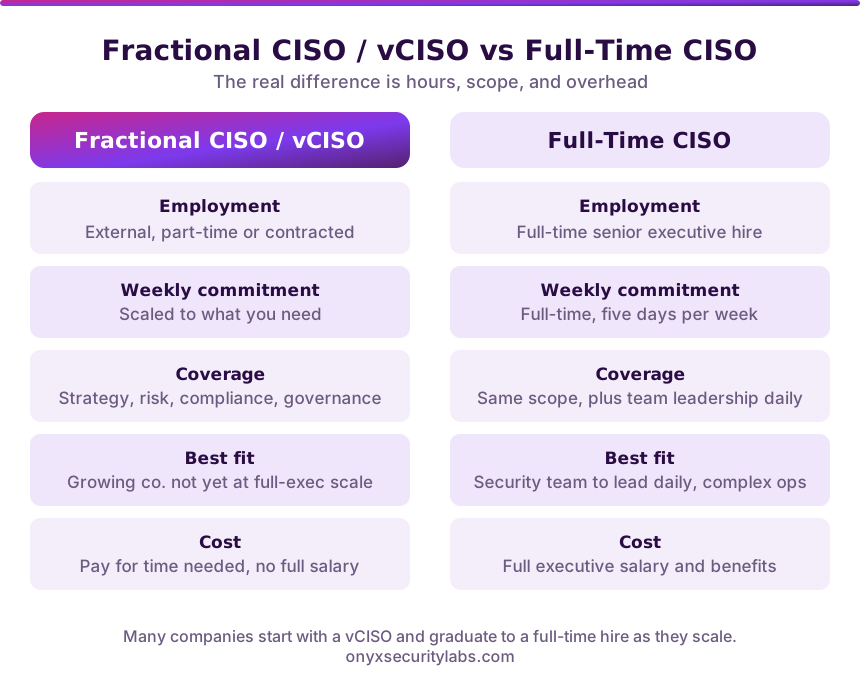
The fractional and full-time CISO comparison comes down to hours, scope, and overhead. Fractional CISOs and vCISOs provide the same calibre of cybersecurity leadership as full-time CISOs, but scaled to your actual needs. They cover the same ground, including SOC 2 and ISO 27001 audit preparation, framework implementation, incident response planning, and oversight of your security program, but without the full-time cost and without the overhead of a full-time hire.
Many companies that cannot afford a full-time CISO find that fractional CISO services cover everything they actually need. The senior security leadership is identical; what changes is the time commitment and cost. This is why "without the overhead" and "without the cost" are recurring reasons companies choose vCISOs and fractional CISOs over full-time hires.
A simple way to decide
Ask how many hours of genuine CISO-level work your business generates each week and how central cybersecurity is to your survival. If the honest answer is "we need the judgement and accountability but not a full week," a vCISO or fractional CISO is your answer. If the answer is "we need someone owning this full-time, leading a team, every day," hire a full-time CISO. Many companies start with a vCISO and graduate to a full-time hire as they scale, which is exactly the right progression.
| Question | If yes, lean toward |
|---|---|
| Do you have a sizeable security team needing daily leadership? | Full-time CISO |
| Is security core to your product or a regulatory requirement at scale? | Full-time CISO |
| Do you need the judgement without a full week of it? | vCISO / fractional CISO |
| Are you running a SOC 2 or ISO 27001 programme without an exec to lead it? | vCISO / fractional CISO |
| Are you not yet ready to justify a full executive salary? | vCISO / fractional CISO |
The bottom line
Fractional CISO and vCISO are the same thing: part-time, external senior cybersecurity leadership. The real choice is between that and a full-time CISO, and it comes down to how many hours of CISO-level work you generate and how central security is to your business. Start with a vCISO if you need the judgement without the full-time overhead, and move to a full-time hire when scale demands it.
How Onyx helps
Onyx provides vCISO services that give you exactly what this decision points toward: senior cybersecurity leadership calibrated to your actual needs and budget. We cover strategy and roadmap, risk management, compliance leadership across SOC 2, ISO 27001, HIPAA, and PCI DSS, governance, and incident response planning. We scope the right level of involvement from the start, and we are direct about when a different model would serve you better.
Want an honest recommendation for your situation?
Tell us your size and risk environment and we will give you a clear steer on a 30-minute call. No obligation.
See also: what is a vCISO, how to choose a vCISO service, and our vCISO service page. Or take the free security self-assessment first.
FAQ
What is the difference between a fractional CISO and a vCISO?
Almost nothing. Both describe an experienced security leader who works with you part-time or on a contracted basis rather than full-time. "Fractional" emphasises the part-time arrangement and "virtual" the external relationship, but the market uses them interchangeably for the same offering.
Should I hire a vCISO or a full-time CISO?
It depends on how many hours of genuine CISO-level work your business generates and how central cybersecurity is. If you need the judgement and accountability but not a full week, a vCISO or fractional CISO fits. If you need a dedicated executive leading a team every day, hire full-time.
When does a company need a full-time CISO instead of a vCISO?
When cybersecurity is large and central enough to demand it: a sizeable security team to lead, security core to your product or regulatory position, constant board and customer scrutiny, complex security operations, or genuinely a full week of CISO-level work. Below that scale, a vCISO or fractional CISO usually fits better.
Is a fractional CISO cheaper than a full-time CISO?
Yes. A fractional or virtual CISO provides senior security leadership part-time, so you pay for the time you need rather than a full executive salary and benefits. It is the cost-effective way to get CISO-level judgement before you are ready for a full-time hire, and it removes the overhead of a full-time in-house CISO.
Can I start with a vCISO and hire a full-time CISO later?
Yes, and many companies do exactly that. A vCISO gives you senior leadership while you grow, builds the security program, and can help you define and hire the eventual full-time role. It is a natural progression as security scales.