


Red teaming and penetration testing both involve skilled people attacking your systems with permission, so buyers often use the terms interchangeably. They are not the same. A penetration test finds and proves as many exploitable vulnerabilities as possible within a defined scope. A red team operation simulates a specific real-world adversary to test whether your people, processes, and technology would actually detect and stop them. Choosing the wrong one wastes budget and answers the wrong question.
Both are forms of security testing that help organizations understand their attack surface, identify attack vectors a malicious actor could use, and improve their overall security posture. The difference is what question each one answers.
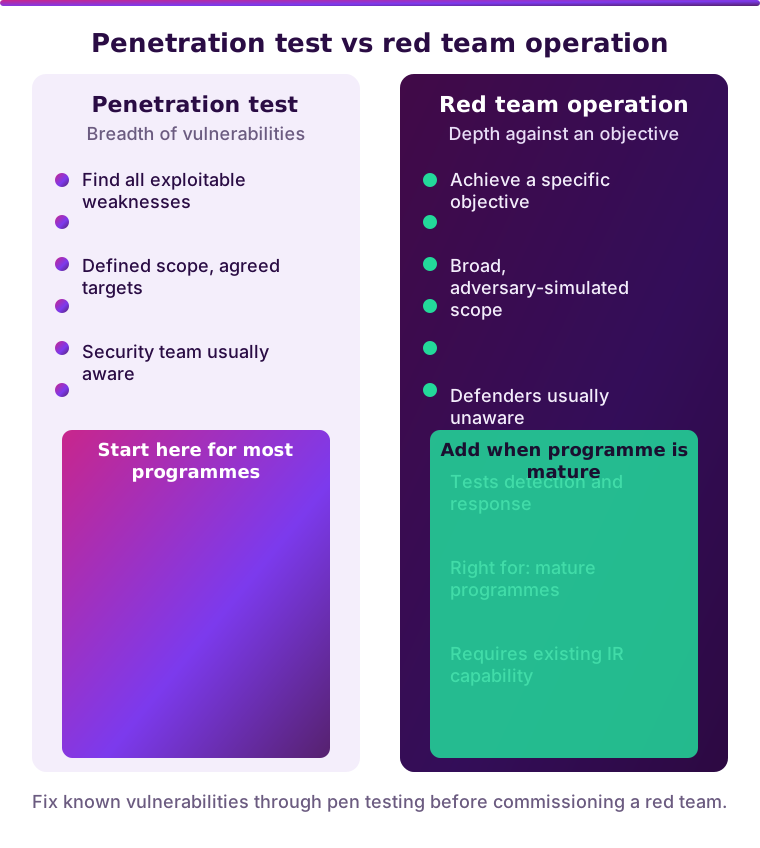
The core difference
A penetration test is breadth of findings within a scope. The goal is to identify and exploit as many vulnerabilities as possible in the agreed targets and hand you a prioritized list of what to fix, the same as any thorough security assessment. Your security team usually knows it is happening, and the penetration tester works through a defined methodology to discover and document all vulnerabilities.
A red team operation is depth against an objective. The goal is to achieve a specific outcome, such as reaching a particular system or dataset, the way a real threat actor would, while staying undetected. It tests your detection and response capabilities, not just your vulnerabilities, and your defenders usually do not know the exact timing. Red team engagement scenarios often include social engineering, physical security probing, and multi-vector attacks that simulate advanced persistent threat actors.
In short: a pen test asks "what vulnerabilities can be exploited here?" A red team asks "if a determined adversary came for us, would we notice and stop them?"
How they differ in practice
| Penetration test | Red team | |
|---|---|---|
| Goal | Find and prove exploitable vulnerabilities | Achieve an objective like a real adversary |
| Scope | Defined targets, as many vulnerabilities as possible | Broad, objective-led |
| Tests | Vulnerabilities and security weaknesses | People, process, and detection and response capabilities |
| Defenders aware | Usually | Usually not (tests blue team response) |
| Best for | Most organisations, compliance, overall security posture | Mature security programmes with incident response teams |
Not sure which fits your security maturity?
Run the free self-assessment and see where your programme stands before choosing.
When a penetration test is the right choice
A penetration test is the right starting point for most organisations. It is what compliance frameworks expect, it gives you an actionable list of vulnerabilities to remediate through vulnerability management, and it is the foundation you build overall security posture on. If you have never had your systems tested, you need a pen test, not a red team assessment.
Spending on a red team before you have fixed known vulnerabilities is paying a specialist to walk through an unlocked door. A vulnerability assessment paired with penetration testing is the baseline cybersecurity programme for most organizations. The penetration tester produces a security assessment that drives remediation and closes the vulnerability management loop; a red team assessment assumes you have already done that work.
When red teaming earns its place
Red teaming makes sense once your security programme is mature: you already run regular penetration tests, you have a security team with detection and response capabilities, incident response procedures, and detection tooling, and you now want to test whether that investment actually works against a realistic, stealthy adversary.
Red teamers often simulate specific threat actors, including advanced persistent threat scenarios, social engineering attacks against staff, and attempts to access sensitive systems across multiple attack vectors while evading your blue team. A real-world attack scenario may include physical security probing alongside digital intrusion.
A note on terminology
You will also hear "purple teaming," where the offensive team and your defenders work together to improve detection and response in real time rather than working covertly, and assumed-breach testing, which starts from the position that an attacker is already inside. These are variations on the red team theme, focused on improving overall security posture and response capabilities rather than just measuring them.
How Onyx helps
Onyx runs manual-led penetration testing for organisations at every stage of security maturity, and red team assessments for programmes that are ready to test their detection and response capabilities. Our testers hold eCPPT, CRTP, and CEH, with CREST-accredited testing available through our CREST-member partner. We will tell you honestly which engagement fits where your programme is today, including if a pen test is the right first step before a red team.
Want an honest recommendation on pen test vs red team?
Tell us where your programme is and we will recommend the right fit on a short call. No obligation.
See also: what is a penetration test, how to choose a penetration testing company, and our penetration testing service. Or start with the free security self-assessment.
FAQ
What is the difference between red teaming and penetration testing?
A penetration test finds and proves as many exploitable vulnerabilities as possible within a defined scope, and your security team usually knows it is happening. A red team engagement simulates a specific adversary or threat actor to achieve an objective while staying undetected, testing your detection and response capabilities, not just your vulnerabilities.
Do I need a red team or a penetration test?
Most organisations need a penetration test, especially for compliance and to get an actionable list of vulnerabilities to fix through remediation. Red teaming suits mature security programs that already run regular pen tests and want to test whether their detection and response capabilities would stop a determined attacker.
Is red teaming more expensive than penetration testing?
Generally yes. Red team operations are broader, objective-led, and more involved, so they take more time and senior effort. They are best commissioned once you have already addressed known vulnerabilities through regular penetration testing.
What is purple teaming?
Purple teaming is when the offensive team and your internal defenders, the blue team, work together during the engagement to improve detection and response in real time, rather than the offensive team operating covertly. It focuses on improving overall security posture and response capabilities rather than only measuring them.
Should a startup get a red team assessment?
Usually not first. A startup is better served by a penetration test to find and fix exploitable vulnerabilities and satisfy customer or compliance requirements. Red teaming becomes valuable later, once a security team and detection tooling, including incident response procedures, are in place to test.