

A vendor security questionnaire lands in your inbox at the worst possible moment: a deal is close, and now a prospect's security team wants forty to two hundred questions answered before they will sign. Answer it well and you accelerate the deal and build trust. Answer it badly and you stall, or worse, commit to controls you do not have. This guide explains what these questionnaires are and how to respond efficiently and honestly.
What a vendor security questionnaire is
A vendor security questionnaire is how an organisation assesses the security risk of a supplier before, and during, working with them. As part of their third-party risk management, your prospect's security team asks you to describe your security practices across areas like access management, data protection, infrastructure, and incident response. The questionnaire might be a custom spreadsheet, a standardised format such as a SIG or CAIQ, or an AI-assisted platform that automatically scores vendor responses. The goal, from their side, is to decide whether trusting you with their customer data is an acceptable risk.
This vendor assessment process is distinct from a full vendor risk assessment, which may include independent testing, but it feeds the same compliance and security standard decisions buyers need to make. Buyers increasingly use AI tools to process and score questionnaire responses at scale, making the speed and quality of your answers even more important.
Why they matter to your deals
For the buyer, you are a potential weak link in their supply chain, and a data breach at a vendor is a breach of their sensitive data. For you, the questionnaire is often the last gate before a contract. Handling it quickly and credibly is a commercial advantage; treating it as an afterthought delays revenue and signals immaturity to a security-conscious buyer.
High-risk vendors, those with access to critical systems or large volumes of customer data, typically face deeper security scrutiny. Understanding your vendor risk profile helps you prepare a proportionate, credible response. Best practices for responding involve treating vendor security questionnaires as a central part of your vendor risk management program, not as an isolated compliance task.
Organisations managing a large vendor ecosystem will encounter questionnaires from multiple customers simultaneously. A consistent, structured approach to vendor responses reduces effort and maintains accuracy across your entire vendor relationship portfolio.
Facing a questionnaire with gaps you cannot answer?
Run the free security self-assessment to get an instant picture of where your program stands before you respond.
How to respond well
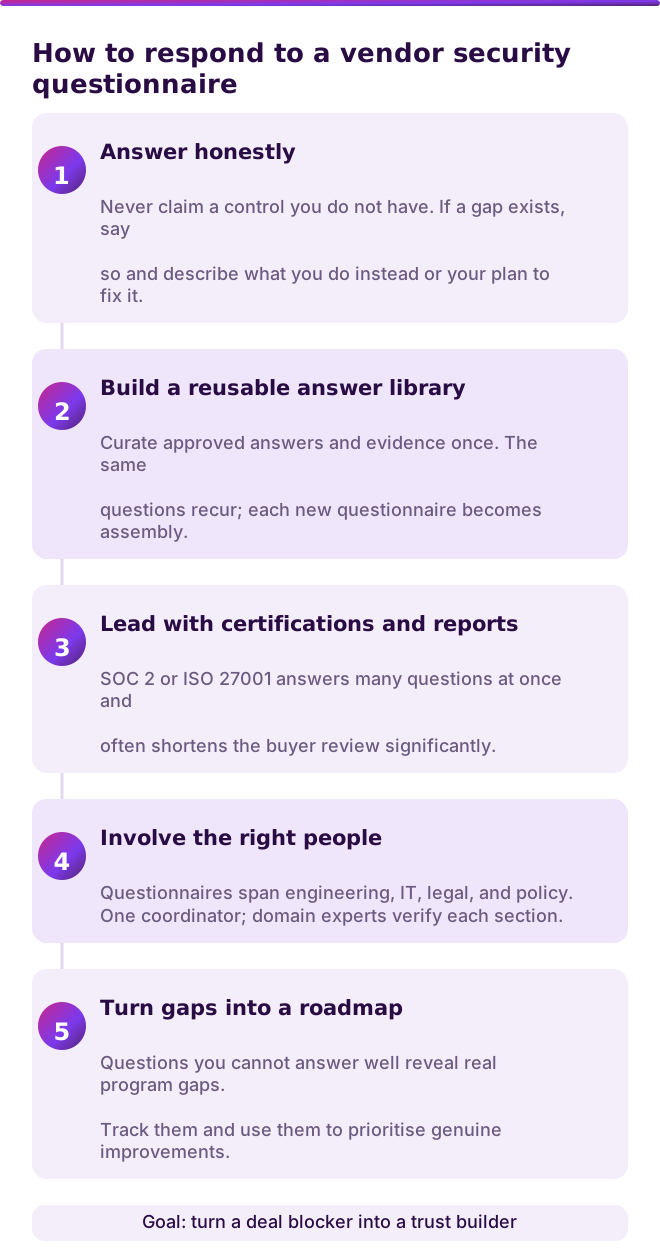
1. Answer honestly
Never claim a control you do not have. Security teams verify, contracts hold you to your answers, and a false claim discovered later destroys trust and can create liability. If you do not do something, say so, and where useful, say what you do instead or when you plan to. Your security posture should reflect your actual security program, not an aspirational one. Be specific about your security measures: describe the information security controls in place, not just their names. Reviewing existing vendor responses and your cloud security architecture before answering helps ensure accuracy.
2. Build a reusable answer library
The same questions recur across questionnaires. Maintain a curated, current set of approved answers and supporting evidence so each new questionnaire is mostly assembly, not authorship. This is the single biggest efficiency gain and makes it easier to streamline your compliance responses across third parties. A good template covers GDPR obligations, your incident response plan, data breach notification procedures, and your security controls. Structure it so any team member can fill in the sensitive information sections accurately.
3. Lead with your certifications and reports
If you hold a SOC 2 attestation report, an ISO 27001 certificate (issued by an accredited certification body), or a similar recognised credential, say so early and share the relevant document. A recognised attestation or certificate answers many questions at once and often shortcuts the whole process, because the buyer's team trusts an independent audit. For buyers conducting a risk assessment, an existing report removes significant uncertainty.
4. Involve the right people
Security questionnaires span engineering, IT, legal, and policy. Have a clear owner who coordinates the right input rather than one person guessing across domains. Involving the right people improves accuracy and reduces the risk of a security incident being overlooked in your responses. When AI tools draft initial answers, a subject-matter expert from each area should review AI-generated content before it is submitted, because AI cannot know what has changed in your environment since the last questionnaire.
5. Use it as a mirror
A questionnaire you struggle to answer is telling you where your security program has gaps. Track the questions you cannot answer well and use them to prioritise real improvements, so the next questionnaire is easier and your vendor risk management posture is genuinely stronger.
6. Automate where it makes sense
Many organisations now use AI-assisted tools to automate questionnaire responses against their existing documentation. AI can match incoming questions to your existing vendor security program answers, flag security incident coverage gaps, and draft responses for human review. When responses are drawn from a maintained knowledge base and reviewed by a human before submission, AI can significantly speed up the process and reduce errors in large questionnaires. This does not replace human judgment on sensitive data handling or new security measures, but it removes the manual burden of repetitive vendor review requests.
Best practices for AI-assisted responses include maintaining a reviewed answer library that AI can draw from, setting clear rules about which security practices can be auto-filled versus those requiring fresh review, and always having a qualified team member sign off before submission. The goal is faster, more consistent responses, not less accurate ones. With cyber threats and data breaches making vendor supply chain risk a boardroom issue, any tool that reduces the burden of vendor security questionnaire compliance while improving accuracy is worth considering.
Common questionnaire formats and standards
Understanding the assessment questionnaire format you are dealing with helps you respond more efficiently. A standard vendor questionnaire template like the Shared Assessments SIG or SIG Lite covers network security, data handling, access management, and business continuity. The Cloud Security Alliance CAIQ focuses on cloud security controls. Custom questionnaires and requests for information vary by buyer, but usually map to the same areas.
Questionnaires and requests for information may also arrive as part of vendor onboarding or vendor management processes, not just new deal evaluation. Maintaining security documentation and up-to-date security policies means you can respond to any format without starting from scratch. Organisations with a strong vendor compliance posture, clear security compliance processes, and regular security awareness training for staff who handle questionnaire data will consistently outperform those who treat responses as one-off events. Understanding your assessment frequency obligations also helps: some contracts require annual security reassessment; others trigger a review after a security incident.
A vendor security assessment is not the same as vendor security ratings tools that scan your external attack surface, but both are part of effective vendor security and risk management. Understanding where each fits helps you give security experts and security insights to the right people for each assessment type. Avoid security theater by ensuring your documented controls reflect what you actually do: comprehensive questionnaires answered with genuine security gaps identified are far more credible than polished answers that do not survive scrutiny. Your expanded vendor base will encounter a wide range of due diligence questionnaires, so consistency matters more than any single perfect response. The Vendor Security Alliance and similar groups publish guidance on what good vendor security documentation looks like.
Common questionnaire areas and what buyers look for
Most vendor security questionnaires cover the same core dimensions regardless of format. The table below maps each area to the evidence buyers typically expect:
| Questionnaire area | What buyers look for | Strongest evidence |
|---|---|---|
| Access management | MFA, least privilege, offboarding process | Policy document, IAM screenshot |
| Data protection | Encryption at rest and in transit, data classification | Architecture diagram, policy |
| Incident response | Documented IR plan, notification timelines | IR plan with breach-notification clause |
| Vulnerability management | Patch cadence, scanning frequency | Patch policy, pentest report |
| Business continuity | RTO/RPO, tested recovery procedures | BCP document, test results |
| Compliance attestation | SOC 2, ISO 27001, HIPAA, PCI DSS | SOC 2: CPA attestation report; ISO 27001: certificate from accredited body; HIPAA: compliance evidence (no official certificate); PCI DSS: AOC or SAQ |
| Third-party risk | Vendor vetting, sub-processor list | Vendor policy, sub-processor register |
The bottom line
A vendor security questionnaire is a buyer assessing whether you are a safe supplier, and it is often the last gate before a deal. Respond honestly, build a reusable answer library, lead with your SOC 2 attestation report or ISO 27001 certificate if you have one, involve the right people, and treat recurring gaps as a roadmap for real improvement. Use the incident response plan section to demonstrate maturity, not just compliance. Done well, it turns a deal blocker into a trust builder.
How Onyx helps
If your organisation struggles to answer vendor security questionnaires credibly, the most durable fix is building the underlying controls, not polishing the responses. Onyx helps organisations close those gaps through SOC 2 readiness, ISO 27001 certification readiness, GDPR compliance, and policies and procedures that give you real evidence to lead with next time.
For organisations that need a security leader to own the program and the questionnaire process, a vCISO provides that function on a part-time basis.
See also: cybersecurity due diligence if a vendor assessment is part of a broader onboarding review, and how to choose a SOC 2 consultant if SOC 2 is next on your roadmap.
Stuck on a security questionnaire, or want to stop dreading the next one?
Tell us your situation and we will help on a short call. No pressure, no obligation.
FAQ
What is a vendor security questionnaire?
It is how an organisation assesses the security risk of a supplier as part of third-party risk management. The buyer asks you to describe your security practices across areas like access management, data protection, infrastructure, and incident response, sometimes in a custom spreadsheet and sometimes in a standardised format like SIG or CAIQ.
How do I respond to a vendor security questionnaire?
Answer honestly, maintain a reusable library of approved answers and evidence, lead with any SOC 2 or ISO 27001 reports you hold, involve the right people across engineering, IT, and legal, and use recurring gaps to prioritise genuine improvements. Speed and credibility help close the deal.
Should I ever overstate a control on a security questionnaire?
No. Security teams verify, contracts hold you to your answers, and a false claim discovered later destroys trust and can create liability. If you do not have a control, say so, and where useful describe what you do instead or your plan to address it.
How can I answer security questionnaires faster?
Build and maintain a curated answer library of approved responses and supporting evidence, because the same questions recur. Lead with your certifications and reports, which answer many questions at once, and assign a clear owner to coordinate input rather than authoring each one from scratch. AI-powered tools can help automate responses against your existing documentation, provided a human reviews each submission. Many security teams now use AI to match incoming questions to existing answers and flag gaps, which speeds up response time without sacrificing accuracy.
Does having SOC 2 help with vendor security questionnaires?
Yes. A SOC 2 or ISO 27001 report is an independent attestation that answers many questionnaire items at once and often shortcuts the process, because the buyer's security team trusts an external audit. Leading with it can significantly speed up the vendor assessment and reduce follow-up questions.