


HIPAA compliance has no certificate and no single price tag, which makes budgeting for it confusing. There is no official "HIPAA certification" to buy; compliance is an ongoing obligation under the Health Insurance Portability and Accountability Act to protect health information through specific safeguards. What you pay depends on your size, how you handle protected health information (PHI), and how mature your security already is. This guide breaks down the real cost drivers so covered entities and business associates can plan accurately.
First, a myth to clear up
There is no government-issued HIPAA certificate. Vendors who sell "HIPAA certification" are offering an attestation or a readiness assessment, not an official stamp, because none exists. HIPAA compliance is demonstrated by actually implementing the required safeguards and being able to evidence them, not by holding a certificate. Understanding this changes how you budget: you are paying to become and stay compliant, not to buy a document.
The Office for Civil Rights (OCR) enforces HIPAA and looks for documented safeguards, a completed risk analysis, and evidence of an ongoing compliance program. Those are the things you need to invest in. The HIPAA privacy rule governs how covered entities and business associates may use and disclose PHI; it works alongside the security rule and both are part of what you are implementing when you build HIPAA compliance. The HIPAA final rule in 2013 (the Omnibus Rule) expanded requirements for business associates and updated breach notification standards, so what it takes to become HIPAA compliant today incorporates those changes.
HIPAA cost depends on a range of factors. The final rule in 2013 made the security and privacy rules more stringent for business associates, which affects how much you need to invest.
What goes into HIPAA compliance cost
HIPAA compliance cost generally comes from these areas:
- A risk analysis (and risk assessment). HIPAA requires a thorough risk analysis of how PHI is created, received, maintained, and transmitted. This is foundational and recurring. Many organizations treat this as a one-time task; it is not. The security rule requires ongoing risk assessments as your environment changes.
- Administrative safeguards. Policies, procedures, workforce training, access management, and a designated security and privacy responsibility. HIPAA policies and procedures must be documented and kept current.
- Technical safeguards. Access controls, audit logging (required specifications), and transmission security for systems handling PHI. Encryption at rest and in transit is an addressable specification under the HIPAA Security Rule (45 CFR 164.312): organisations must assess whether it is reasonable and appropriate, document that decision, and implement an equivalent alternative if they choose not to encrypt. In practice it is almost always the right call. Note: HHS published proposed Security Rule updates in December 2024 that, if finalised, would make several currently addressable specifications, including encryption, required. Monitor HHS.gov for developments.
- Physical safeguards. Controls over facilities and devices where PHI lives.
- Business Associate Agreements (BAAs). Putting the required contracts in place with business associate vendors that handle PHI on your behalf. Every vendor in scope needs a BAA.
- Breach response planning. Having processes to detect, document, and notify in the event of a breach of PHI reduces both the likelihood and the cost of a data breach.
- Remediation and ongoing maintenance. Fixing the gaps the risk analysis finds, and maintaining compliance over time. A compliance audit or HIPAA audit may be conducted internally or by a third party to verify controls. HIPAA compliance is continuous, not a project you complete once.
- HIPAA training. Workforce training is an administrative safeguard requirement. Ongoing HIPAA training keeps staff aware of their obligations.
| Cost component | What it covers | Recurring? |
|---|---|---|
| Risk analysis | Assessment of PHI flows, threats, and vulnerabilities | Yes, as environment changes |
| Administrative safeguards | Policies, procedures, workforce training, access management | Yes, ongoing updates |
| Technical safeguards | Access controls, encryption, audit logging, transmission security | Yes, maintained |
| Physical safeguards | Facility and device controls for PHI | Yes, reviewed periodically |
| BAAs | Contracts with every vendor handling PHI | Yes, as vendors change |
| Breach response planning | Detection, notification, and documentation processes | Yes, tested regularly |
| Ongoing maintenance | Remediation, audit readiness, evidence collection | Yes, continuous |
Trying to budget for HIPAA without guessing?
Run the free self-assessment to see your current posture before you scope any spend.
What drives HIPAA compliance cost up or down
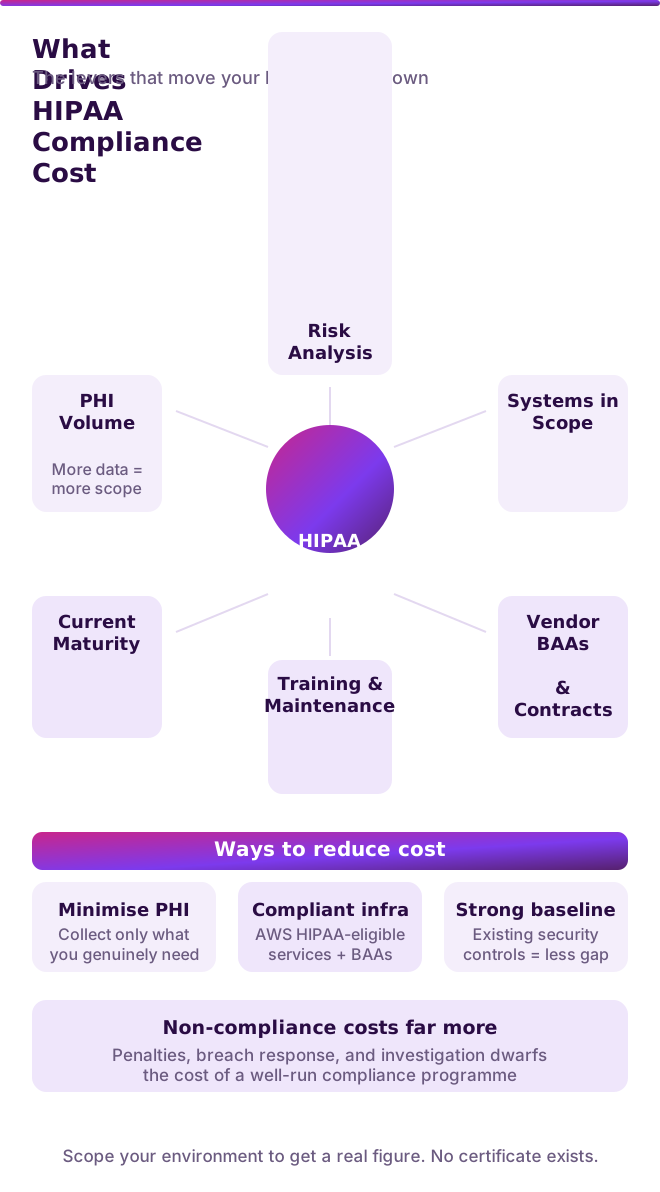
The cost of HIPAA compliance rises with the volume and sensitivity of PHI you handle, the number of systems and vendors in scope, and how far your current controls are from the requirements. It falls when you already have strong security foundations, when you reduce how much PHI your systems touch, and when you use compliant infrastructure and vendors that come with BAAs.
Healthcare providers and healthcare systems typically face higher compliance costs because of the breadth of PHI they handle. A startup healthcare provider or digital health company entering the market for the first time will need to comply with HIPAA from the ground up, which is where the cost of HIPAA compliance is highest relative to size.
A HIPAA audit cost varies significantly by scope. An internal audit focused on a single system is far less expensive than an enterprise-wide third-party assessment. The estimated cost of HIPAA compliance at the enterprise level can run into hundreds of thousands annually for large healthcare organizations; for a small business associate, the cost of compliance is much lower if scope is managed.
Several cost components are worth calling out:
- Compliance officers. Larger organizations designate full-time compliance officers; smaller ones share this responsibility or outsource it.
- Compliance automation and compliance platforms. Modern compliance platforms can reduce the manual burden of evidence collection, policy management, and ongoing monitoring, which lowers the opportunity cost and the compliance burden on your engineering and operations teams.
- HIPAA violations and penalties for HIPAA violations. Non-compliance with HIPAA is far more expensive than compliance. Penalties for HIPAA violations are tiered by level of culpability under HHS/OCR and adjusted periodically for inflation; see HHS.gov for the current penalty schedule. The cost of a data breach, including notification, investigation, and regulatory penalties, dwarfs the cost of running a sound compliance program.
HIPAA risk, violations, and the cost of non-compliance
Understanding HIPAA risk is part of sizing the compliance investment. The HIPAA security rule and HIPAA privacy rule (the HIPAA final rule updated substantially in 2013 through the Omnibus Rule) set out compliance requirements that all covered entities and business associates must meet. Organisations that do not protect patient information face enforcement action from the Office for Civil Rights. Penalties for HIPAA violations are tiered by culpability and can be substantial; see HHS.gov for the current penalty schedule.
Becoming HIPAA compliant and remaining HIPAA compliant are two different challenges. The cost of a HIPAA violation, including investigation, remediation, and potential regulatory penalty, far exceeds the cost of a well-run HIPAA compliance program. HIPAA civil penalties are tiered by level of culpability under HHS/OCR and are adjusted periodically for inflation; check HHS.gov for the current penalty schedule. Much of HIPAA compliance today comes down to having documented HIPAA risk assessments, a functioning HIPAA program with dedicated compliance ownership, and evidence of ongoing HIPAA safeguards. An onsite HIPAA assessment by a qualified third party can help verify your controls before an OCR audit.
For organisations with complex compliance needs, HIPAA plus HITRUST or SOC 2 may be on the table; pursuing HITRUST certification alongside HIPAA adds cost but consolidates security and compliance evidence into a single framework. The average cost of HIPAA compliance activities also depends on whether you use federal HIPAA standards as a baseline alongside any additional HIPAA regulations that may apply to your specific healthcare context. HIPAA journal resources and OCR guidance are useful references. How much HIPAA compliance costs ultimately depends on scope, maturity, and how HIPAA cost is allocated across engineering, operations, and governance. The typical cost for a small business associate with a limited PHI footprint is far less than for a large healthcare system, but overall compliance across all three safeguard categories is required regardless of size.
How to control HIPAA compliance cost
Start with the risk analysis, because it tells you where to spend rather than spreading effort thinly. Reduce scope by limiting where PHI flows and using compliant platforms and vendors. Implement the safeguards you would want for good security anyway. Build a HIPAA compliance program with clear ownership so you are achieving and maintaining compliance continuously rather than scrambling before a deadline. Having HIPAA policy templates in place for common administrative safeguards reduces the time needed to document and update your procedures.
Getting help to scope correctly means you address genuine HIPAA requirements rather than over-investing in things that do not move your compliance forward. Achieving HIPAA compliance from a strong security foundation costs less than retrofitting weak security controls later.
The bottom line
HIPAA compliance cost is driven by your size, how much PHI you handle, and your current maturity, spread across a risk analysis, administrative, technical, and physical safeguards, BAAs, breach planning, training, and ongoing maintenance. There is no certificate to buy; you are paying to implement and sustain the safeguards under the HIPAA security rule and privacy rule. Start with the risk analysis and scope tightly to get a real figure.
How Onyx helps
Onyx's HIPAA compliance service is built around giving you a defensible, scoped compliance programme rather than an over-engineered one. We run the foundational risk analysis that tells you where to spend, identify the specific gaps in your technical and administrative safeguards, and build the documented evidence base your enterprise customers and any OCR review will ask for.
We help you scope the PHI footprint tightly, work with your engineering team to implement the technical controls, and structure the BAA process for your vendor relationships. Because we work across engagements in this space, we know where effort is genuinely required and where over-investment adds cost without adding compliance value.
See also: HIPAA compliance for startups: a practical guide, HIPAA compliance service.
Want a real HIPAA budget rather than a range?
Tell us how you handle PHI and we will scope it on a 30-minute call. No obligation.
FAQ
How much does HIPAA compliance cost?
The cost of HIPAA compliance depends on your size, how much PHI you handle, and your current security maturity. Cost spans a risk analysis, administrative, technical, and physical safeguards, BAAs, breach planning, HIPAA training, and ongoing maintenance. Estimated cost ranges widely: small business associates may spend tens of thousands annually, while large healthcare providers spend significantly more. There is no certificate to buy; you pay to implement and sustain the safeguards. Scope your environment for a real figure.
Is there an official HIPAA certification?
No. There is no government-issued HIPAA certificate. Vendors offering "HIPAA certification" provide an attestation or readiness assessment, not an official stamp. Compliance is demonstrated by implementing the required safeguards under the Health Insurance Portability and Accountability Act and being able to evidence them.
What is the biggest factor in HIPAA compliance cost?
The volume and sensitivity of PHI you handle and how far your current controls are from the HIPAA security rule requirements. Reducing where PHI flows, using HIPAA-compliant infrastructure and vendors, and having strong security foundations all lower the cost of compliance.
Is HIPAA compliance a one-time cost?
No. HIPAA compliance is an ongoing obligation. You must maintain safeguards, keep your risk assessment current, train your workforce, and update controls as your environment changes. Budget for continuous compliance, not just an initial project.
Where should I start with HIPAA compliance?
Start with the required risk analysis of how PHI is created, received, maintained, and transmitted. It is foundational and tells you where to focus, so you spend on genuine requirements rather than spreading effort thinly or over-investing in the wrong areas.