


If your startup touches health data, HIPAA is not optional, and it tends to arrive faster than founders expect: the moment a health system, payer, or covered-entity customer wants to work with you. The good news is that HIPAA compliance for startups is manageable if you approach it deliberately. This guide explains when it applies, what it requires, and how to build it in without slowing the product down.
When HIPAA applies to a startup
HIPAA applies if you handle protected health information (PHI) in one of two roles. You are a covered entity if you are a healthcare provider, health plan, or clearinghouse. Far more commonly, a startup is a business associate: a vendor that creates, receives, maintains, or transmits PHI on behalf of a covered entity. If you build software or services that handle patient data for healthcare customers, you are almost certainly a business associate, and HIPAA obligations follow.
Covered entities and business associates both carry obligations under the Health Insurance Portability and Accountability Act (HIPAA). Those obligations are typically formalised in a Business Associate Agreement (BAA) your customer requires you to sign. HIPAA applies to healthcare startups, digital health startups, and telehealth companies from the moment they begin handling PHI, not just when they scale.
Many startups ask: when does a startup need to be HIPAA compliant? The answer is from day one of handling PHI. There is no grace period, and HIPAA compliance from day one is both possible and less expensive than retrofitting later.
What HIPAA requires
HIPAA's Security Rule sets out safeguards across three categories, plus foundational requirements:
- A risk analysis. The starting point: assess how PHI is created, received, maintained, and transmitted, and identify threats and vulnerabilities to it.
- Administrative safeguards. Assigned security responsibility, policies and procedures, workforce HIPAA training, and access management. Organization must document these and keep them current.
- Technical safeguards. Access controls, audit controls and logging (required specifications under 45 CFR 164.312(b)), and transmission security for systems handling PHI. Encryption of PHI at rest and in transit is an addressable specification under the HIPAA Security Rule (45 CFR 164.312): organisations must assess whether it is reasonable and appropriate for their environment, document that decision, and implement an equivalent alternative if they choose not to encrypt. In practice, encryption is widely considered best practice and most organisations implement it.
- Physical safeguards. Controls over devices and facilities where PHI lives.
- Business Associate Agreements (BAAs). The contracts that pass HIPAA obligations to vendors that handle PHI for you. Both the BAA your customer requires and the BAAs you need with your own vendors must be in place.
- Breach notification. Processes to detect, document, and report breaches of PHI as required. HIPAA breach notification obligations are triggered when unsecured PHI is compromised.
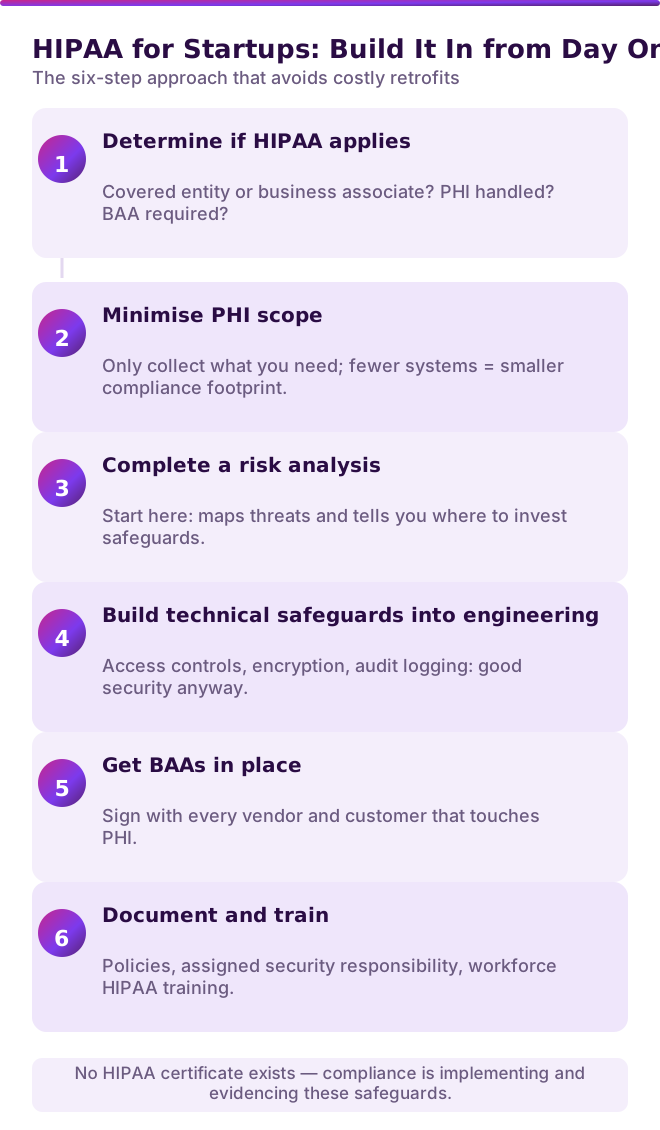
There is no HIPAA certificate; compliance means implementing and evidencing these safeguards. HIPAA compliance for startups means building these controls into engineering and operations from the start, not bolting them on.
Selling to healthcare and not sure where you stand on HIPAA?
Run the free 15-question self-assessment to get an instant readiness score across your security and compliance posture.
How a startup should approach HIPAA compliance
The startups that handle HIPAA compliance well do a few things consistently:
- Minimise PHI. Only collect and store the health data you genuinely need, and keep it in as few systems as possible. Less PHI means smaller scope, lower risk, and lower compliance cost. This is the most powerful way to manage HIPAA compliance for startups.
- Use HIPAA-compliant infrastructure. Build on cloud providers (such as AWS with its HIPAA-eligible services) and vendors that support HIPAA and will sign a BAA. A HIPAA-compliant infrastructure means you inherit strong safeguards and can focus your effort on application-level controls.
- Start with the risk analysis. It tells you where to invest rather than spreading effort thinly. Many startups skip this and spend on the wrong controls; those that prioritize the risk analysis build a more efficient compliance program.
- Build technical safeguards into engineering. Access controls and audit logging are required technical safeguards; encryption is an addressable specification that organisations must assess and, in almost all cases, implement. All three are good security practice anyway; building them in early is far cheaper than retrofitting. A HIPAA-compliant infrastructure from day one avoids the technical debt of a mid-product overhaul.
- Get the BAAs right. Both the BAA your customer asks you to sign and the BAAs you need with your own vendors that handle PHI. Sign a BAA with every vendor that touches PHI.
- Treat HIPAA compliance as a competitive advantage. Healthcare startups that prioritize compliance win enterprise deals faster. Being able to say your systems meet HIPAA requirements is a deal-enabler, not a checkbox.
Healthcare startup teams often worry that HIPAA compliance requires a dedicated compliance officer. For most small startups, an assigned security responsibility held by an engineer or founder, supported by a compliance platform or outside guidance, is sufficient to get started. Many teams also automate workflow steps around evidence collection, policy review, and access control auditing to reduce manual burden as they scale.
Failing to achieve HIPAA compliance carries real risk. A HIPAA violation can result in a fine from the Office for Civil Rights; penalties are tiered by level of culpability under HHS/OCR and adjusted periodically for inflation. See HHS.gov for the current penalty schedule. Healthcare providers and other covered entities routinely require a signed BAA before onboarding a new vendor, so compliance is directly tied to your ability to close deals.
Every startup handling PHI should have a written privacy policy that describes how health data and other sensitive data is collected, used, and protected. This supports both your HIPAA administrative safeguards and broader trust with customers. Pair it with technical security measures to meet the HIPAA Security Rule requirements: access controls and audit logging are required specifications; encryption is an addressable specification that must be assessed and documented, and is best practice in virtually all environments. A thorough risk assessment completed at the outset ensures your security measures address the actual threats your systems face.
The bottom line
A startup needs HIPAA compliance when it handles protected health information (PHI), usually as a business associate to healthcare customers. The HIPAA security rule requirements are a risk analysis plus administrative, technical, and physical safeguards, BAAs, and breach notification processes, with no certificate to buy. Approach it by minimising PHI, using HIPAA-compliant infrastructure, and building safeguards into engineering early, and HIPAA compliance becomes a deal enabler rather than a roadblock.
How Onyx helps
Onyx's HIPAA compliance service supports startups and scale-ups entering healthcare markets. We run the foundational risk analysis, identify the gaps in your technical and administrative safeguards, help you structure your BAA process, and produce the documented evidence your enterprise customers will ask for at due diligence. There is no certificate to hand over; what your customers want is evidence that the safeguards are real and documented, and that is what we help you build.
We work alongside your engineering team, not around it, so the controls go in with the product rather than on top of it. For a fast read on where you stand right now, the free self-assessment covers the areas healthcare customers typically probe first.
See also: HIPAA compliance cost: what drives the price, HIPAA compliance service.
Healthcare customer asking for a BAA or HIPAA evidence?
We scope the path and the effort on a 30-minute call. No obligation.
FAQ
When does a startup need to be HIPAA compliant?
From day one of handling PHI. If a startup creates, receives, maintains, or transmits protected health information on behalf of a healthcare provider, health plan, or clearinghouse, it is a business associate and HIPAA obligations apply immediately, typically formalised in a Business Associate Agreement.
What does HIPAA require a startup to do?
Conduct a risk analysis and implement administrative, technical, and physical safeguards: assigned security responsibility, policies, HIPAA training, access controls, audit logging (required specifications), and transmission security. Encryption is an addressable specification: you must assess whether it is reasonable and appropriate, document the decision, and in most cases implement it. You also need BAAs with your customer and your own vendors, and breach notification processes. There is no certificate; you implement and evidence the safeguards.
Is there a HIPAA certification for startups?
No. There is no official HIPAA certificate. Vendors offering "HIPAA certification" provide an attestation or readiness assessment, not an official stamp. Compliance is demonstrated by implementing the required safeguards under the Health Insurance Portability and Accountability Act and evidencing them.
How can a startup reduce HIPAA scope and cost?
Minimise the PHI you collect and store, keep it in as few systems as possible, and build on HIPAA-compliant cloud infrastructure with vendors that will sign BAAs. Less PHI in fewer systems means less scope, effort, and cost. A HIPAA-compliant infrastructure from day one avoids expensive retrofits.
What is a Business Associate Agreement?
A Business Associate Agreement (BAA) is the contract that passes HIPAA obligations to a vendor handling PHI on behalf of a covered entity. As a startup serving healthcare customers, you will typically sign a BAA with your customer and need BAAs with your own vendors that touch PHI. Covered entities and business associates must have signed BAAs in place before PHI is shared.